Addressing the Cruise Industry Crew Shortage 

It is predicted that by 2030, the cruise industry will feel a global crew shortage. According to a study by Cruise Lines International Association (CLIA), the intent to cruise stands at 82%, yet the supply of qualified crew is not meeting this growing demand. But as the industry continues to grow and significant new vessels join fleets, crewing agents and managers are facing this increasing challenge in sourcing the next generation of crew. 

Group of yacht crew sat on the deck in a line

This shortage isn’t only felt by the cruise industry looking for its next Captains, officers, engineers, or hospitality staff; it’s also felt in the yachting industry.  

A career at sea is not a new concept; however, it is still widely inaccessible. A recent survey conducted by the UK’s Department of Transport found that only 20% of students would consider a career in the maritime sector.  

But can you blame them?  

The Crew Shortage Amongst Young People

When the most desired careers by teens are doctors, lawyers, footballers, and artists, not all of these translate to a life at sea. There is also the appeal of becoming a paid influencer or content creator, with flexible hours and schedules suited to your lifestyle.  

The widening job market, of course, isn’t the only factor responsible for the lack of new crew. However, it is a contributing one. The study also revealed that 38% of students said enjoyment in a subject or career was the most important factor for them, with 2% choosing opportunities to work abroad or travel. But what if we could align seafaring careers with these values? 

Beyond the apparent lure of adventure, careers at sea offer creative challenges, a strong sense of community, and a clear sense of purpose that aligns well with what many young people seek. Working with diverse teams to solve unique problems on board can provide immense satisfaction and fulfilment. This means for many students, the idea of pursuing a cadetship should be considered not as just ‘leaving school’ but as stepping into a vibrant career path that meets modern priorities.  

Cultral Shifts Affecting the Crew Shortage

As we’ve moved into a more health-conscious world, post-COVID, with a much more sustainable work-life balance for many, long contracts (working seven days a week for up to six months or more) are no longer appealing. Instead, employees are prioritising their mental and physical health by working in hybrid roles at shore, and switching off at the weekend, allowing a rest before the working week begins again on Monday.  

Yacht engineer working on engine

In response to this shift, the cruise industry is implementing onboard initiatives designed to support wellness at sea. Many cruise ships now feature state-of-the-art gym facilities, mental-health support programs, including regular rotations for relaxation, and wellness workshops. These changes are part of an effort to align with modern work-life balance ideals, making life at sea more attractive to potential recruits. 

Seafarer Retention and Incentives

The challenge is not solely about recruitment, however. Retention and promotion are equally critical. The cruise industry is fiercely competing for qualified engineers, many of whom are drawn to well-paid shoreside roles. Having said this, there are evidently many who do love this lifestyle, with the cruise industry supported by the estimated 200,000 seafarers on board cruise ships.  

The retirement of the current workforce does necessitate finding fresh crew to replace them, and this responsibility doesn’t fall solely on recruitment agencies. While recruitment agencies play a critical role in filling positions, it’s crucial for various stakeholders to participate in building a sustainable talent pipeline.  

How can We Rectify the Crew Shortage?

Schools can integrate maritime studies into their curriculum to spark early interest among students, parents can encourage exploration of diverse career paths, and current crew members can share their experiences to inspire and mentor the next generation. By fostering collective action from schools, parents, current crew, and agencies, we can ensure a steady flow of motivated and trained individuals ready to embark on vibrant careers at sea. 

External view of cruise ship that is facing crew shortage

Through our efforts at Viking Maritime Group, we encourage those looking for a new career path to consider one at sea. By giving talks to students at local and national schools and colleges and encouraging Travel and Tourism students to participate in Personal Survival Techniques training sessions, we’re opening doors they previously might not have known existed.  

If you’d like to be a Captain of a luxury Superyacht or would be interested in pursuing an engineering career onboard a cruise ship, then discover our helpful blogs, for more information on how to get started. 

Lien’s Career At Sea Journey

We sat down with Viking Crew’s Assistant Placement Manager, Lien Eggermont, to learn more about her spontaneous career at sea, and the inspiring opportunities a life at sea can offer.

What made you consider a career at sea?

Lien: “I hadn’t really considered a career at sea before my time as a stewardess. In all honesty, I was thrown into the industry, as my partner was working on board yachts at the time, and there was a vacancy for a stewardess on the vessel.

In 2008, after leaving my job as an Overseas Representative for Thomas Cook, I joined my partner on board a sailing yacht, for a French billionaire.

I was only 24 or 25 at the time, and with the owner being French, it was very easy for me to communicate with him, as I am from Belgium.

I worked on that yacht for two years, before working as a stewardess for a Russian family . Then two years later, we joined a charter yacht for the season.

We stayed there until March 2013, when we then took over a Motor Yacht, and had three busy charter seasons on board, cruising the Mediterranean with international guests.”

Was a career at sea always an option for you?

Lien: “No, I grew up in Belgium where there isn’t much of a coastline, so a career at sea, or yachting, was never something I had considered. The industry had always been much more of a ‘secret society’ and wasn’t advertised as widely as it is now.

Therefore, if it wasn’t for my partner encouraging me to join him at sea, I probably wouldn’t have had a career at sea at all.”

What was your role?

Lien: “I began as a stewardess, and worked my way up to a chief stewardess over the course of seven years, always having worked in the interior department.

Being a stewardess involved doing laundry, setting tables for meals, cleaning areas, all to a very high standard. However, it can also involve being a cook, or helping out on the deck – it’s very varied.

The owner of the first yacht I worked on loved fishing, and so unfortunately, he wanted me to make soup with his catch of the day! Gosh, how I hated the smell of that soup.”

Would you recommend a career at sea?

Lien: “Yes, I would recommend a career at sea. You get to see so many places, and if you’re lucky and get the chance to go ashore, you should definitely take the opportunity. The south of France is always nice, Italy and the Turkish coastlines are also very pretty. Every place has something special that you remember.

You also get to work with different cultures on board, and learn to understand and appreciate them. In the yachting industry you may work closely with influential people, and can learn a lot from them as well.”

Would you still choose a career at sea if you were a young person/teen now?

Lien: “I don’t regret my career before becoming a stewardess, because as a teenager I didn’t know this industry existed. I studied Travel and Tourism at University, so I always enjoyed learning about travel.

Also, Belgium isn’t a seafaring country, so a career at sea wasn’t something I had connections to.” 

What opportunities can a career at sea offer?

Lien: “Working at sea will certainly set you a few steps ahead for when you come ashore. Especially if you’re savvy with your money you will have a nice pot of savings to support you when you leave.

Working at sea will also give you the opportunity to learn lots of transferable skills which can easily be transferred back ashore, especially within the hospitality industry. If you work on luxury, high-end yachts, you’ll have been dealing with potentially very difficult clients, which teaches you to be more resilient, for example.”

What advice would you give to someone deciding on a career at sea?

Lien: “Especially for younger people, I would advise finding a job that is related to the career at sea they would like to follow. A lot of clients require some level of work experience, to prepare the seafarer for their career at sea. Therefore, I would advise working in a high-end hospitality role such as a restaurant or hotel. A couple of years experience is ideal before transferring to yachts.”

Is there a life after Yachting?

Lien: “After spending a few years at sea, you might decide you want to move back ashore, and it’s another lifestyle change. You suddenly have to rewrite your CV and seven years of yachting have to be explained to shorebased employers who are not familiar with the industry.

It’s essential that you have financial security behind you before you make the move. There are suddenly a lot of bills to pay, you’ll need to buy a house, car, workwear, (forget the shorts & T-shirts) to prepare you for your new life…I found a lot of helpful information on a Facebook group for stewardesses, about how to transfer yachting skills, which helped me a lot.

At the time, P&O Ferries in Dover was looking to set up a Communications Team that would give operational updates to their tourist & freight customers. The team would work 24/7, sending updates in four languages, on X (formerly known as Twitter) and other social media platforms. So, I applied, and was successful.

It was shift work, which I didn’t mind as I was used to the long hours on the yachts. The job was still in the maritime industry and when Captains would call in about technical issues, I had an understanding of what they were referring to, as I had helped out on deck and was able to explain it to disgruntled customers.”

It was great talking to Lien and discovering more about her career at sea.

If you’re looking for your next exciting position at sea? Click here to explore our current vacancies at Viking Crew.

Date of Issue: 19th June 2024
Last Edited: 16th August 2024

An Insight to Emily’s Career At Sea

We caught up with Viking Crew Head of Crewing, Emily Jaenicke, to discover more about her career at sea, and the different paths that can lead to a life at sea.

What made you consider a career at sea?

Emily: “Living by the coast certainly had an influence on my decision to start a career at sea. Sailing on ferries as a child to go on family holidays, as well as my grandfather being in the Royal Navy, meant that I grew up surrounded by ships. This, combined with my interest in travel, amongst other reasons, definitely contributed to my decision to start a career at sea.”

Emily with fellow crew members on board a ship

Was a career at sea always an option for you?

Emily: “I don’t think I actually thought about what I wanted to do as a teenager. I studied my GCSEs, A Levels, and then went to university to study Physics. Towards the end of my first year, however, I began questioning why I was there.

I couldn’t see myself using my degree in a teaching career, so thought, “what am I doing?” My brother at the time was already studying a cadetship, and suggested I consider working on cruise ships.

So I gave Viking Maritime Group a call, they had an open position for a cadet, and I had the academic background they were looking for, which led to an interview.

It was all very coincidental timing. I had just finished my first year of university, received my results, and was planning on returning to studies for my second year. However, the intake for a cadetship at Warsash Maritime School was starting in a few weeks, so I decided to enrol. The rest is history. I guess it was meant to be really.”

What was your role?

Emily: “After leaving university, I began my cadetship as a Deck Cadet, training to be a Navigation Officer. The first phase of college was six weeks of basic STCW sessions, which gave me the tools to complete my first sea phase.

During the first phase, I worked with the deck crew. This involved a lot of painting, chipping, working with ropes, and learning the basics of the nautical side of shipping. As well as, working with the deck crew for anchoring, mooring, maintenance, and greasing etc.

Then I went back to college, expanded my knowledge where I could then later put it into practice during my next sea phases. I worked closely with bridge officers, working with the charts, learning celestial navigation, and planning routes. It’s a very practical way of doing things.

Then at the end of the three years, I sat a 1:1 verbal exam with a master mariner who assessed me on everything I had learnt in the last three years.”

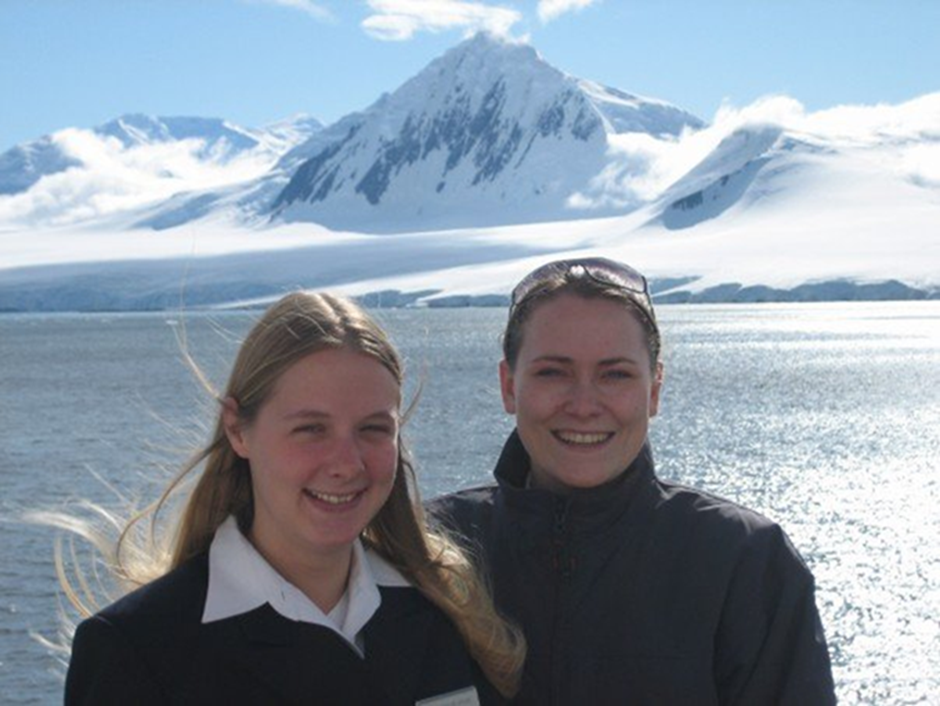
Emily and a fellow cadet stood in front of snowy mountains | Career at sea

Would you recommend a career at sea?

Emily: “100%, yes I would recommend a career at sea. It definitely changed me. I came back much more independent, and appreciative of different cultures and religions, as you gain more of an understanding of the world. I travelled to Africa, down to Antarctica, the Caribbean, the Baltic, and saw both sides of Russia. It was absolutely incredible and you get paid to do it at the same time.

You really get to understand why people say, “you’re all in one boat”. You have no choice but to get along with each other, and it makes you a much more rounded individual as a result.

Additionally, I gained an appreciation for the industry. As an island, the UK is limited in which foods and materials can be produced, so it makes you appreciate the importance of the shipping industry and how it needs nourishing. Even if you’re not at sea, you’re connected to it somehow. This is similar to how we offer support services here at Viking Crew. Ships can’t run without the people ashore, so you’re part of a team, making the whole ecosystem work.”

Would you still choose a career at sea if you were a young person/teen now?

Emily: “Yes, I would. Maybe not in the order I did it, but you can’t turn back time, and I don’t regret that path. It definitely made me grow up and it instilled a work ethic that I still have today. In any position, you shouldn’t have the mentality of “that’s not my job”, because we’re all working towards one goal and we all have to chip in and help out, otherwise things aren’t achieved.”

What opportunities can a career at sea offer?

Emily: “Travel. Friendships. Maturity. Independence. Resilience. Multitasking. Good all-round skills that are transferable in lots of different ways, so that when you eventually come ashore, you can apply these skills to your role.”

A selfie taken by Emily as she is on the mast of a ship | Career at Sea
Windstar Cruises Windsurf – Largest sailing cruise ship, Emily finished her cadetship on board here sailing around the Caribbean. Masts are 80m high (16 double decker buses)

What advice would you give to someone deciding on a career at sea?

Emily: ”Go for it! Just because you’re deciding to do something now, doesn’t mean you can’t change your mind in five years time. If it’s something you think you want to do, what are you actually risking by giving it a try?

I’d also advise sailing on a ship somewhere before you embark on a life at sea. I had a family member that tried a career at sea, after seeing how much my brother and I enjoyed ourselves, but they got very sea sick! So it’s a good idea to make sure that’s not going to be an issue for you.”

It was great speaking to Emily and getting an insight to a different pathway of starting a career at sea, but nevertheless, a very successful one.

University and higher education might not be for you, but have you considered a career at sea? Check out our helpful blogs to give you some tips and advice on a career at sea.

Or if you’re looking for your next role at sea, then view our full list of vacancies here.

Date of Issue: 23rd April 2024
Last Edited: 16th August 2024

Previous

Ready to Apply?

Apply with 1 click with your
Viking Crew Account.

Don’t have one? Click below to register and complete your profile

Register

Login